
KLAYVI Natural Clean Kit
Out of StockYour dish soap is destroying your clay. Here is what does not.
Natural · Sisal scrubber + Sea salt sachet + Coconut shell powder · SKU: KL-KT-002
₹199.00
| Material | Natural |
|---|---|
| Size / Capacity | Sisal scrubber + Sea salt sachet + Coconut shell powder |
| Induction Ready | NO |
| XRF Tested | NO |
| Sub-Category | Cleaning Kit |
Your dish soap is destroying your clay. Here is what does not.
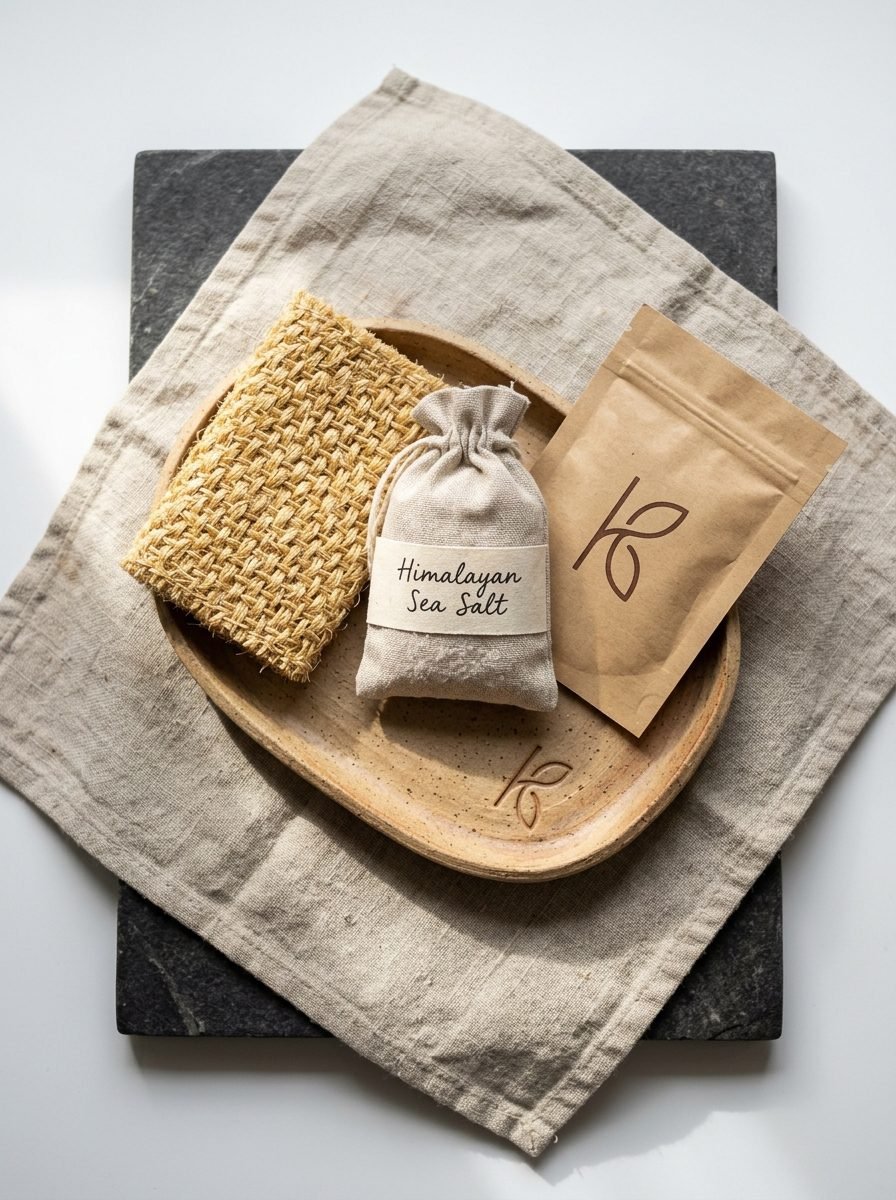
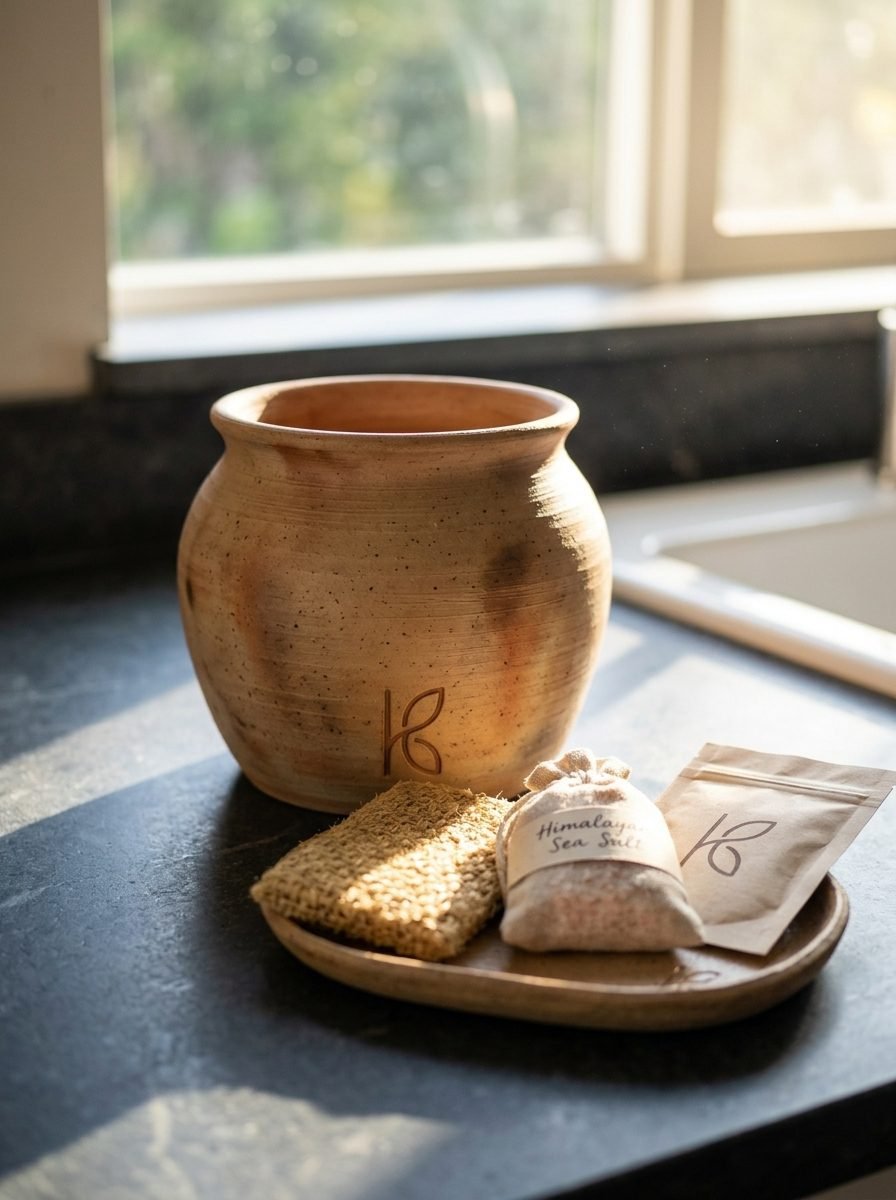
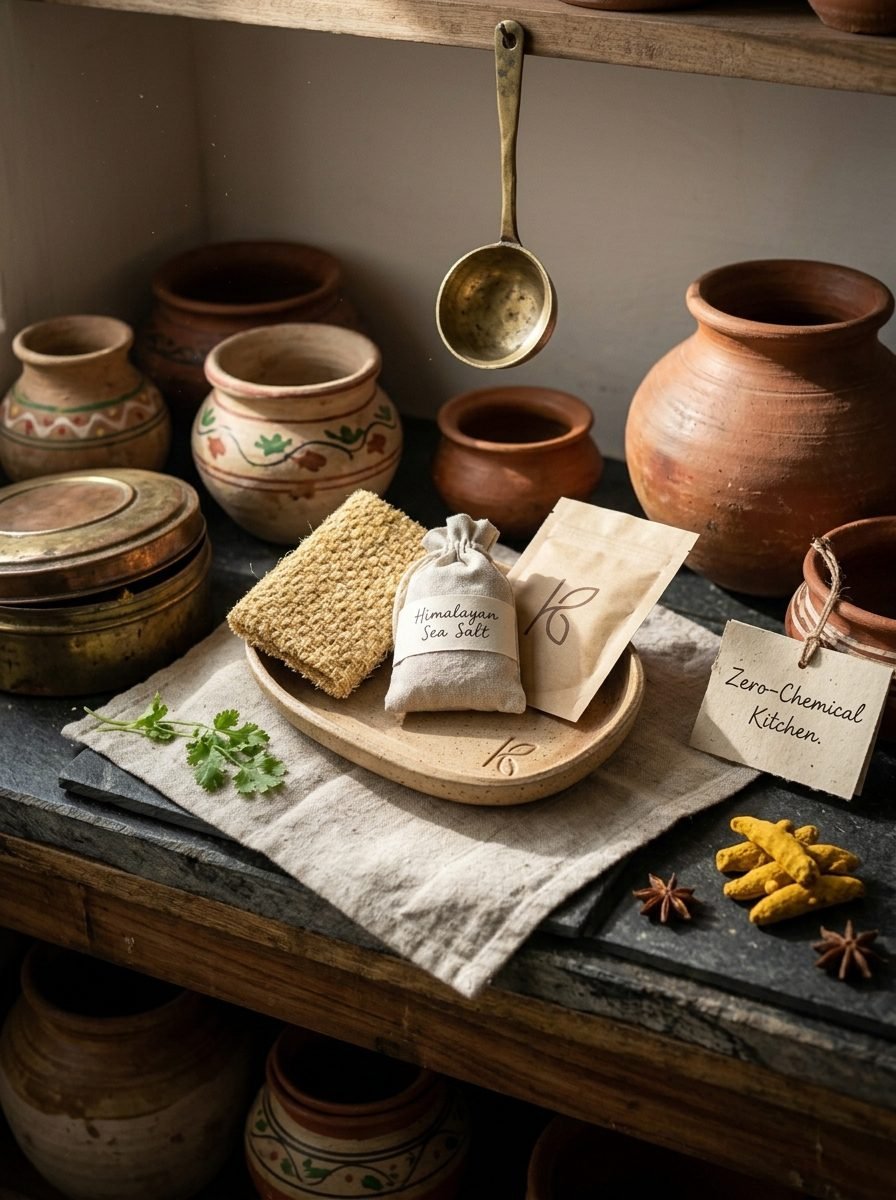
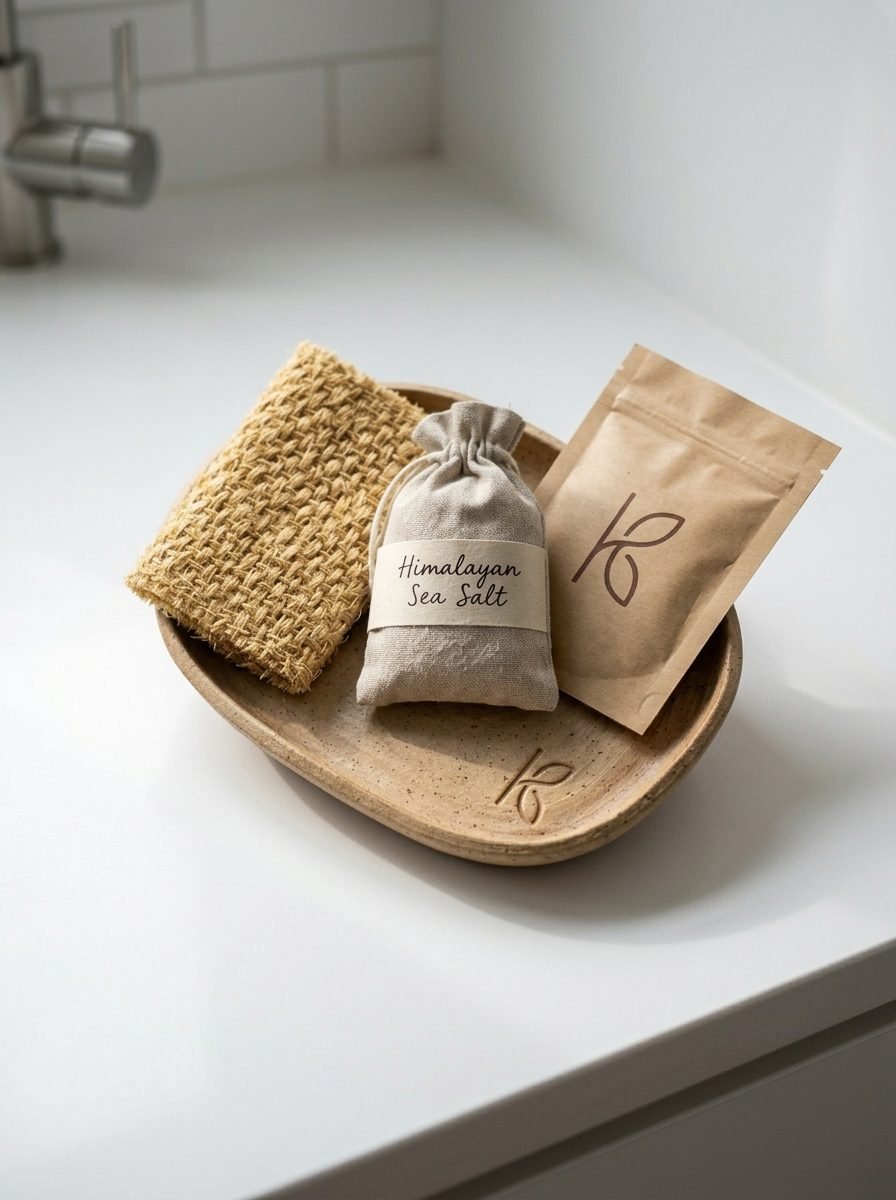
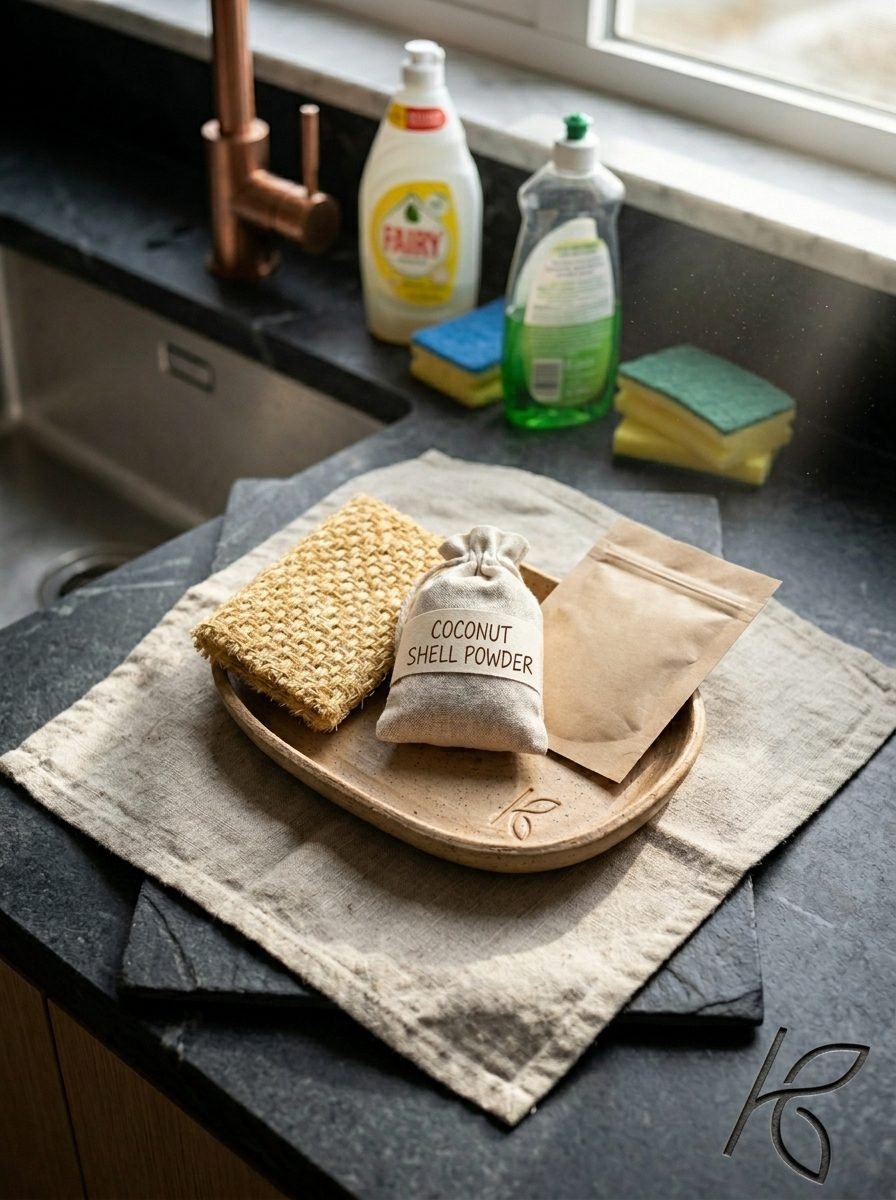
Three natural cleaning components that replace dish soap entirely for clay care. A sisal fiber scrubber, a linen sachet of Himalayan rock salt, and a kraft packet of coconut shell powder. All three are used in combination for cleaning clay at pH neutral — without the pH 9–11 damage that standard dish soaps cause to the polymerised flaxseed oil seasoning layer that gives clay cookware its non-stick properties. This is not alternative wellness packaging. It is applied surface chemistry.
Key Features & Benefits
- Why Standard Soap Destroys Clay: Standard dish soap surfactants (SLS, SLES) operate at pH 9–11. At this pH, they attack the ester bonds in the polymerised flaxseed oil seasoning layer through saponification — the same reaction used to make soap from fat. One dish soap wash cycle can damage the seasoning. Three or four can strip it completely. The Natural Clean Kit operates at pH neutral.
- Sisal Scrubber — The Right Abrasion: Natural sisal fiber (from Agave sisalana) provides mechanical soil removal without the pH damage of detergent. The fiber’s natural hardness cleans food residue from clay surfaces without scratching the Ra ≤4µm finish. Rinse and air-dry between uses. Lasts 2–3 months of daily use.
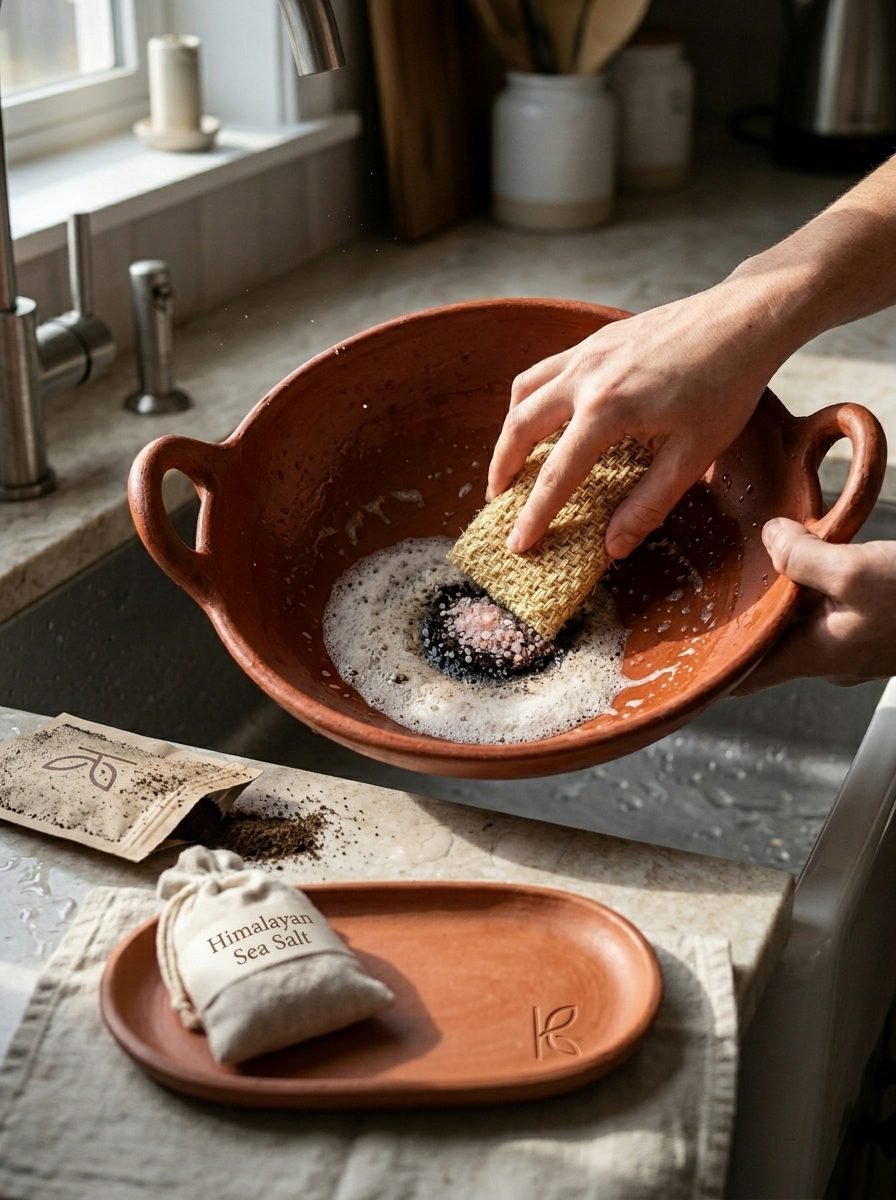
- Himalayan Rock Salt — The Original Scrub: Abrasive enough to remove stuck food when rubbed with the sisal scrubber. pH neutral (sodium chloride in water is pH 7.0). Antiseptic at the concentrations created by a salt scrub. The traditional Indian kitchen cleaning method, validated by food science.
- Coconut Shell Powder — The Deodoriser: Fine-grained activated charcoal-rich powder derived from coconut shells. Absorbs oils and odours from clay surfaces without stripping the seasoning. Particularly effective for removing the slightly bitter smell that can develop in clay vessels after prolonged use without seasoning maintenance.
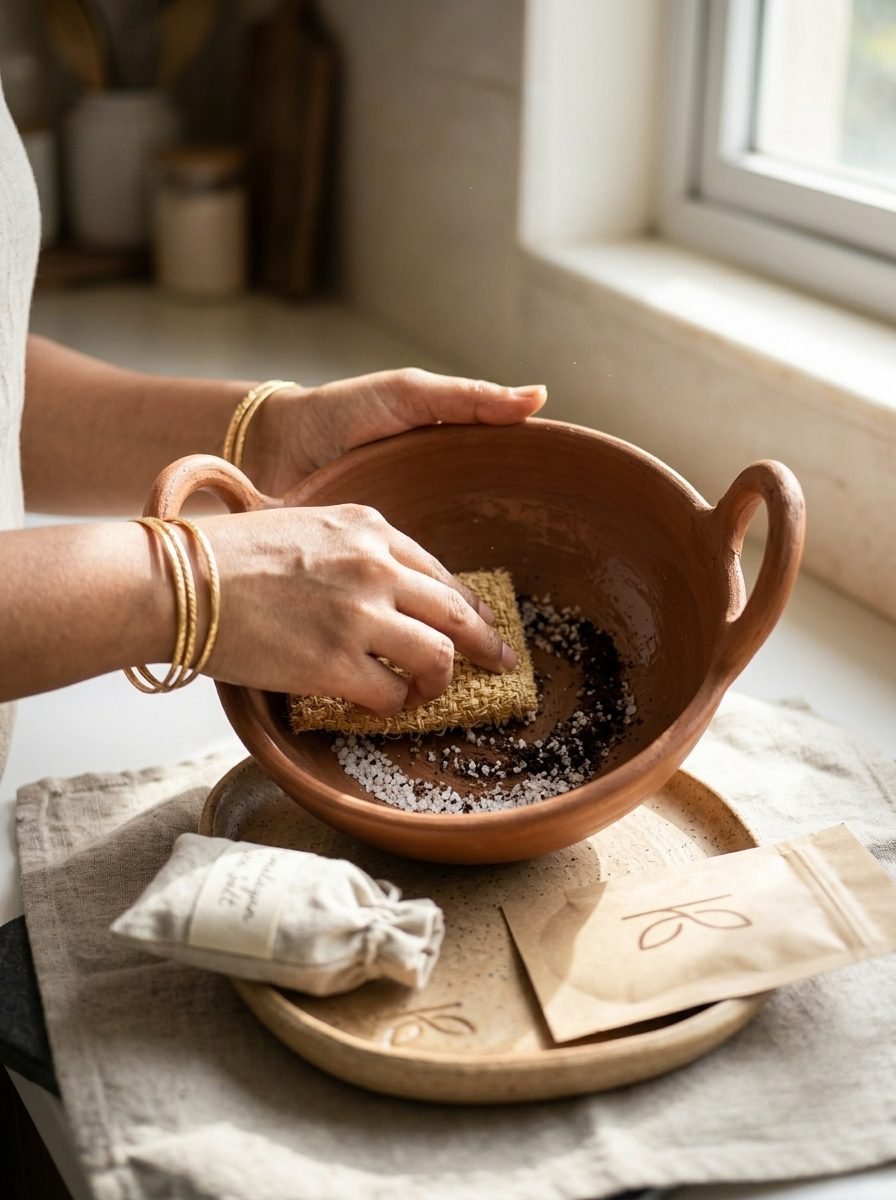
- Complete Cleaning Protocol in the Kit: The protocol card in the kit: pour a small amount of coconut shell powder onto the vessel surface. Add a pinch of salt. Scrub with the damp sisal scrubber. Rinse with warm water. Place on low flame for 2 minutes to dry completely. Total time: 3 minutes.
- Refillable System: The sisal scrubber is replaced every 2–3 months. The salt and coconut shell powder are refillable from standard sources (Himalayan salt from any supermarket; activated coconut charcoal powder from health stores). The cleaning kit is designed as an ongoing system, not a one-time purchase. About the Product The sisal fiber is sourced from Agave sisalana — a natural plant fiber with the specific mechanical properties that make it ideal for clay: coarse enough for food removal, fine enough not to damage the clay surface. The Himalayan rock salt is unprocessed mineral salt from Pakistan, ground to medium crystal size — coarse enough for abrasion, fine enough to dissolve with water contact. The coconut shell powder is produced from the shells of mature coconuts, kiln-activated at 800°C to create the maximum surface area for odour absorption. No chemical activation, no synthetic binders. The powder is fine enough to enter the clay pores and absorb residual oils and odours that water cleaning cannot reach. The Science The key chemistry: flaxseed oil polymerises onto clay at the molecular level, filling the micro-pores and creating a non-reactive surface layer. This polymer layer is the clay’s non-stick mechanism. SLS (sodium lauryl sulphate) in standard dish soap saponifies (breaks down) this polymer through an alkaline ester hydrolysis reaction. At pH 9–11, the ester bonds in the polymerised oil are cleaved, the cross-linked polymer unravels, and the non-stick layer is destroyed. Sisal fiber, rock salt, and activated coconut charcoal operate at pH 6.5–7.5. No saponification occurs. The polymer layer is preserved. Food residue is removed mechanically and through the absorptive properties of the activated charcoal. The clay is clean. The seasoning is intact.
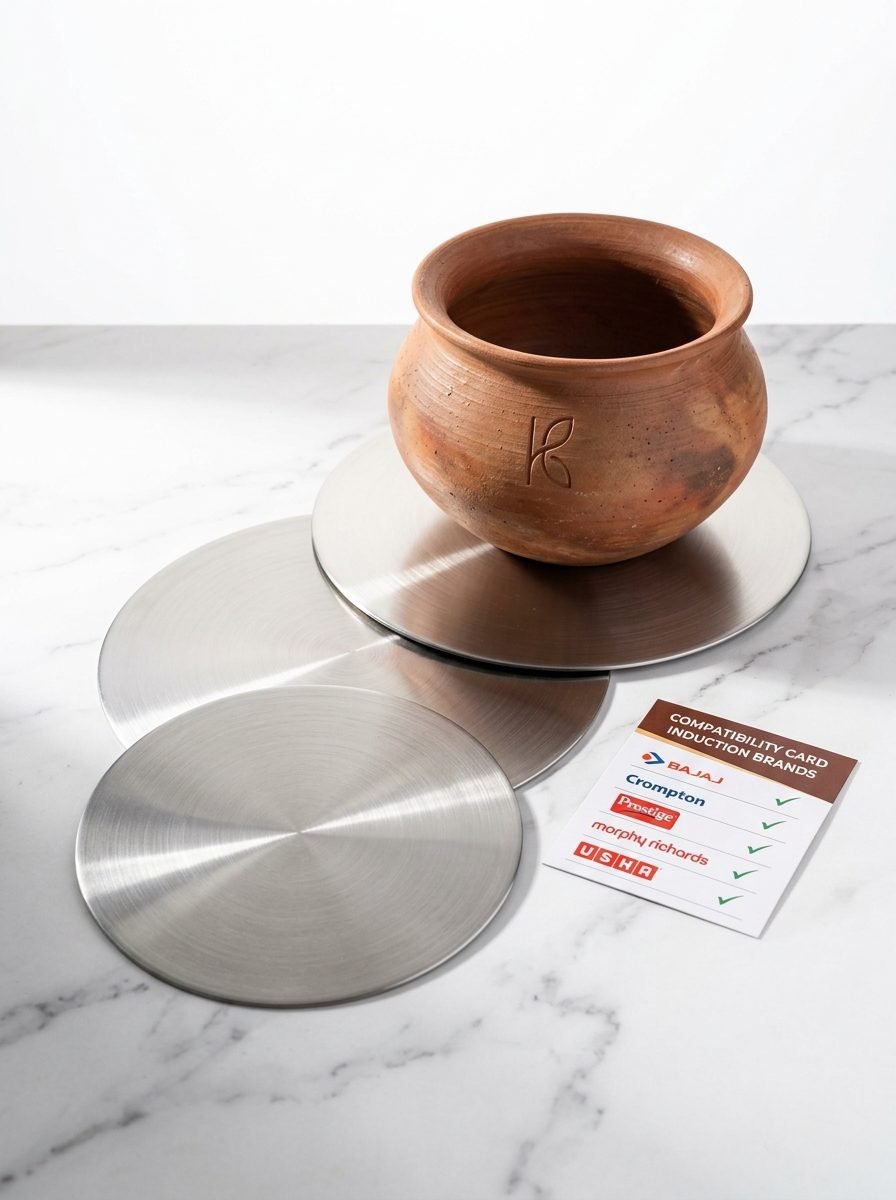
- How It Works: The induction cooktop creates a changing electromagnetic field. The ferromagnetic steel disc becomes the induction heating element. The clay vessel sits on the disc and receives heat conductively from the steel. The clay then distributes that heat in its characteristic even, slow way. Physics, not magic.
- Three Sizes for All Klayvi Vessels: 12cm: tadka pans, small sauce pans (600ml). 14cm: sauce pans (1L, 1.5L), kadhais (1L, 1.5L), patilas (1.5L). 16cm: all handi sizes, kadhai 2L and 3L, tawa 10/12/14 inch, slow cooker, large patilas.
- 2mm Cold-Rolled Steel — The Correct Thickness: Thinner: warps under repeated thermal cycling. Thicker: too much thermal mass, slow heat transfer, low efficiency. At 2mm, the disc achieves equilibrium temperature quickly and maintains it stably.
- Food-Grade Silicone Edge Sleeve: Prevents burns when handling. The disc becomes very hot during use — the silicone sleeve creates a safe grip point without conducting the full heat of the disc surface to your fingers.
- Tested on 5 Major Indian Induction Brands: ≥80% efficiency achieved on all five. Efficiency means: if the clay vessel were induction-compatible, it would heat at 100%. With the disc, it heats at 80%+. Practical implication: set the induction level 1–2 notches higher than you would for direct metal cookware.
- Develops a Natural Seasoning: The disc develops a natural patina from cooking oil that drips or splashes from the clay vessel above. This patina is the cast iron effect — it improves the disc’s non-stick properties over time. About the Product Cold-rolled steel (CRS) is the correct material for induction adapter discs because: (1) it is ferromagnetic — the electromagnetic field induces eddy currents in it efficiently; (2) it is food-safe — no harmful alloys or coatings that could degrade under repeated heating; (3) it has excellent thermal conductivity for even heat spread; (4) it is affordable and widely available in precision sheet metal form. The 12cm, 14cm, and 16cm graduated sizes are determined by the base diameters of our clay vessels. Each disc should be approximately the same size as the clay vessel base that sits on it: larger disc = larger contact area = more even heat distribution. Using a disc significantly smaller than the vessel base reduces efficiency and concentrates heat at the disc edges. The Science Induction efficiency through a steel adapter disc is reduced from 100% (direct induction) to 78–83% (through disc) for two reasons: (1) the disc has some thermal mass that absorbs heat before it reaches the clay vessel, reducing the proportion of energy that reaches the food; (2) there is a conductive thermal resistance at the disc-to-clay interface that depends on how flat and smooth the contact is. These losses are fixed at approximately 17–22% regardless of induction power level. The practical compensation — setting the induction 1–2 levels higher — is sufficient to achieve equivalent cooking performance.
Safety & Certification Standards
| XRF Analysis — Clay Source | Heavy metal screening on raw clay before production begins |
| ICP-OES — Finished Product | Parts-per-billion accuracy. Actual migration into food simulants at cooking temperatures |
| NABL-Accredited Laboratory | Internationally recognised test facility |
| FSSAI Food Contact Compliance | Meets India’s legal food safety standards |
| Per-Batch QR Report | Your batch. Your numbers. Published before dispatch. Scan and read it yourself. |
| Actual Lab Numbers | Compound |
| Klayvi Result | FSSAI Safe Limit |
| Lead (Pb) | ≤2.1 ppm |
| 90 ppm | Cadmium (Cd) |
| ≤0.3 ppm | 0.5 ppm |
| Arsenic (As) | ≤0.4 ppm |
| 2.0 ppm | Mercury (Hg) |
| Not detected | 0.5 ppm |
| PTFE / PFOA / PFAS | Not present |
| Zero tolerance | XRF Analysis — Clay Source |
| Heavy metal screening on raw clay before | production begins |
| ICP-OES — Finished Product | Parts-per-billion accuracy. Actual migration into food simulants at cooking temperatures |
| NABL-Accredited Laboratory | Internationally recognised test facility |
| FSSAI Food Contact Compliance | Meets India’s legal food safety standards |
| Per-Batch QR Report | Your batch. Your numbers. Published before dispatch. Scan and read it yourself. |
| Actual Lab Numbers | Compound |
| Klayvi Result | FSSAI Safe Limit |
| Lead (Pb) | ≤2.1 ppm |
| 90 ppm | Cadmium (Cd) |
| ≤0.3 ppm | 0.5 ppm |
| Arsenic (As) | ≤0.4 ppm |
| 2.0 ppm | Mercury (Hg) |
| Not detected | 0.5 ppm |
| PTFE / PFOA / PFAS | Not present |
Caring for Your Klayvi
| 1 — First Use | Rinse with plain water. No soap on first use. |
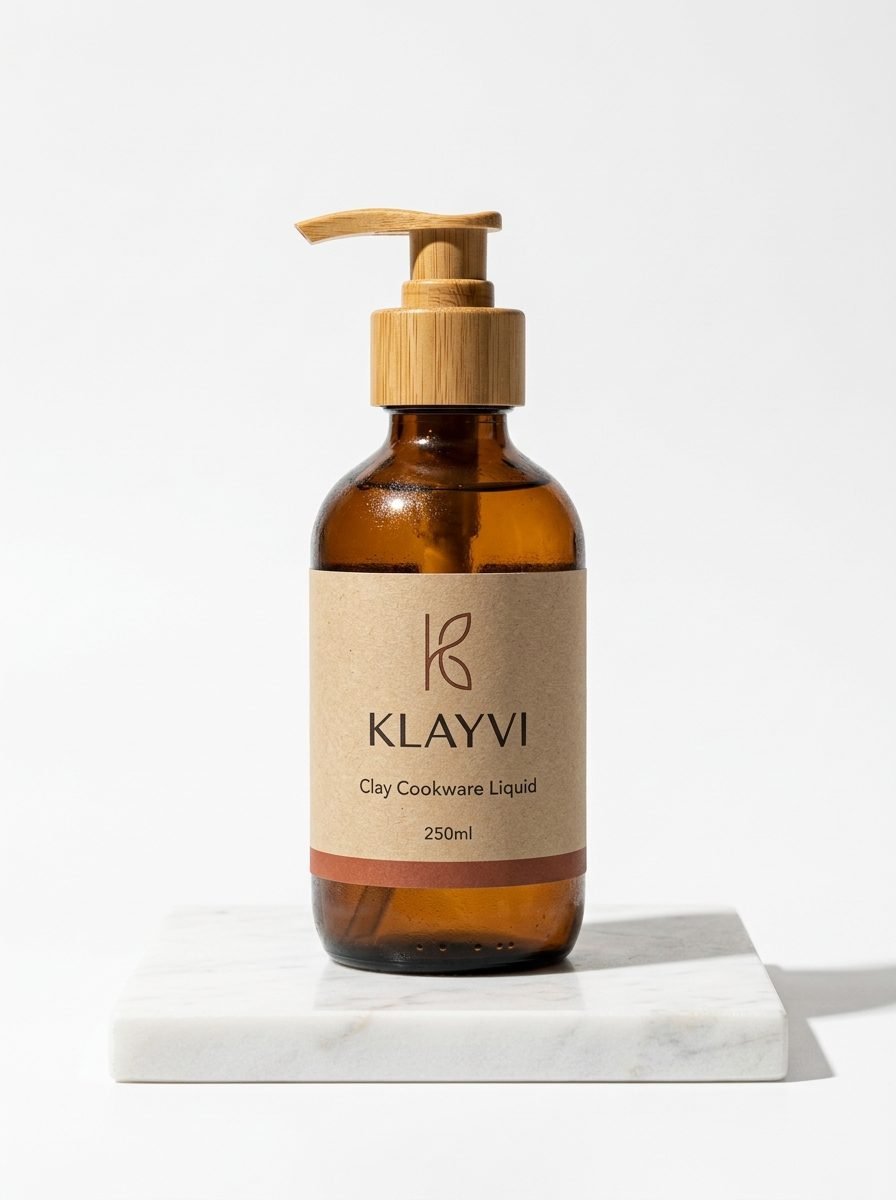
| 2 — Daily Clean | Klayvi Wash Care (pH 6–8) or sisal scrubber + warm water. Never standard dish soap. |
| 3 — After Wash | Dry completely on low flame (cookware) or air-dry (storage/decor). Never store damp. |
| 4 — Monthly | Apply 4–5 drops cold-pressed flaxseed oil. Heat medium-low ~4 min. Cool and wipe. |
| 5 — Never | Dishwasher · Microwave · Chemical detergents · Cold water on hot clay · Overnight soaking |
| 1 — First Use | Rinse with plain water. No soap on first use. |
| 2 — Daily Clean | Klayvi Wash Care (pH 6–8) or sisal scrubber + warm water. Never standard dish soap. |
| 3 — After Wash | Dry completely on low flame (cookware) or air-dry (storage/decor). Never store damp. |
| 4 — Monthly | Apply 4–5 drops cold-pressed flaxseed oil. Heat medium-low ~4 min. Cool and wipe. |
| 5 — Never | Dishwasher · Microwave · Chemical detergents · Cold water on hot clay · Overnight soaking |
What’s in the Box
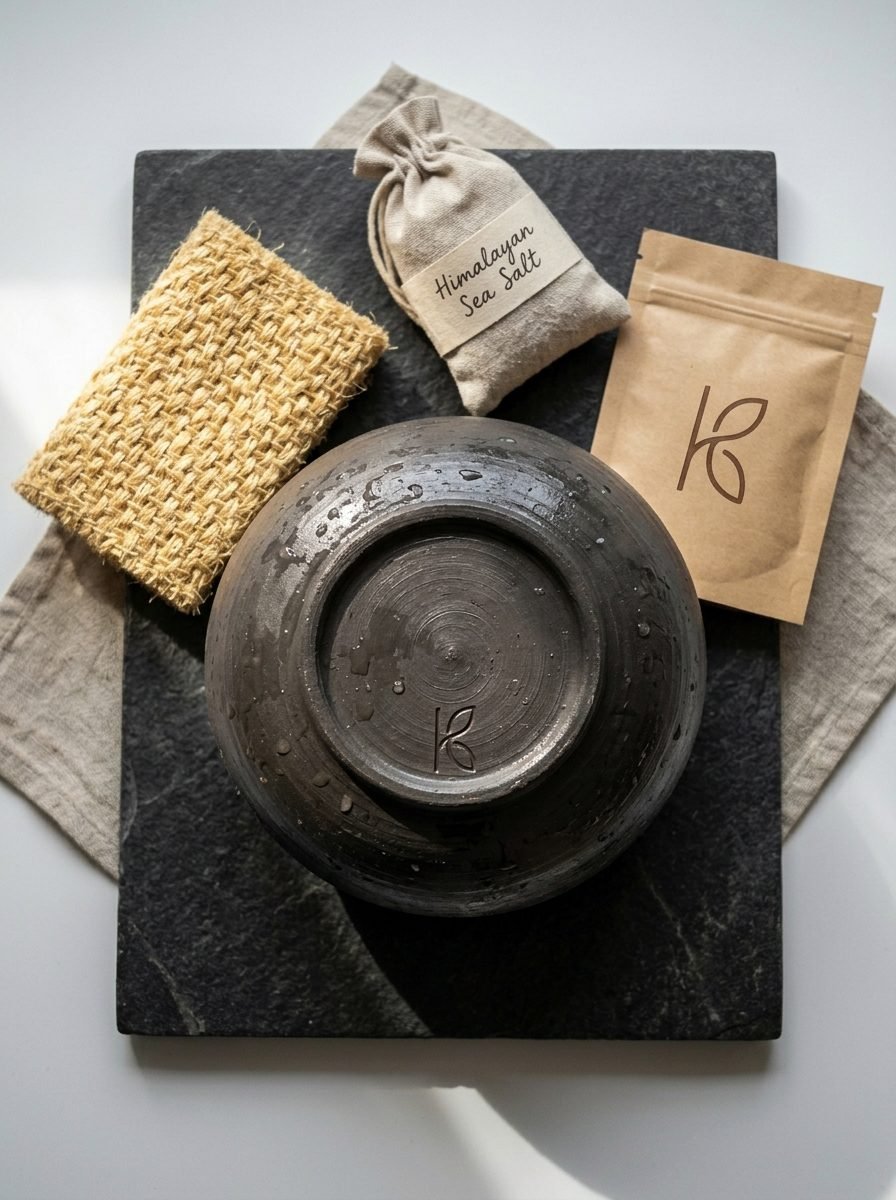
- Sisal fiber scrubber (natural Agave sisalana, hand-formed)
- Himalayan rock salt sachet 50g (linen pouch)
- Coconut shell activated charcoal powder 30g (kraft packet)
- Natural cleaning protocol card
- Induction Adapter Disc 12cm (food-grade silicone edge)
- Induction Adapter Disc 14cm (food-grade silicone edge)
- Induction Adapter Disc 16cm (food-grade silicone edge)
- Brand compatibility chart and settings guide
- Disc care card
Frequently Asked Questions
Q: How long does each component last?
Sisal scrubber: 2–3 months of daily use. Rock salt sachet: approximately 30 cleaning sessions (1–2 months). Coconut shell powder packet: approximately 20 cleaning sessions. All are refillable from standard commercial sources.
Q: Can I use this kit on glazed clay surfaces (Bone Kaolin, Aqua-Lock)?
Yes, with slight modification: use only the sisal scrubber (no salt or charcoal powder) on glazed interiors. The glaze is smooth and does not retain food residue the way unglazed clay does. Warm water and the sisal scrubber is sufficient for glazed surfaces.
Q: Is the Natural Clean Kit safe if residue is left on the clay after cleaning?
All three components are food-safe. A small amount of sisal fiber left in the clay surface will wash away with water on first heating. Rock salt residue dissolves in water. Coconut charcoal residue is food-grade and harmless in trace amounts. None of the three components are toxic if trace amounts enter food.
Q: Can I use regular table salt instead of the Himalayan rock salt?
Yes — the key property is the crystal size and pH neutrality, not the mineral source. Regular iodised table salt works but the added iodine has a slightly antiseptic effect that can subtly affect the clay surface over time. Rock salt (without iodine) is preferred.
Q: How do I store the sisal scrubber between uses?
Rinse thoroughly after each use, squeeze out excess water, and hang or stand upright to air-dry. Do not store damp (promotes mould in the sisal fiber). In a well-ventilated spot, the scrubber dries completely between daily cleaning sessions.
Q: Does the Natural Clean Kit remove tannin staining from clay chai vessels?
The coconut shell powder is particularly effective for tannin staining. Apply directly to the stained area, add a small amount of water to make a paste, let stand 5 minutes, scrub with the sisal scrubber. Rinse well. Multiple applications may be needed for heavy staining, but most tannin staining responds to 2–3 treatments. Induction Adapter Disc Set KL-KT-003 · Set: 3 Discs (12cm, 14cm, 16cm) · 2mm Cold-Rolled Steel · Food-Grade Silicone Edge Yes, clay works on induction. We tested it on five brands. Here is the disc set. Three ferromagnetic steel discs of graduated sizes that sit between your clay vessel and the induction cooktop surface, converting electromagnetic induction into conductive heat for clay. 12cm, 14cm, and 16cm diameters. 2mm cold-rolled steel. Food-grade silicone sleeve on all edges. Tested on Prestige PIC 16.0, Bajaj ICX 3, Philips HD4938, Pigeon Favourite, and Usha Cook Joy. Achieves ≥80% induction efficiency versus direct-induction-compatible cookware on all five brands.
Q: Which disc do I use for my kadhai 2L?
The 14cm disc. The kadhai 2L has a base diameter of approximately 13–14cm. The 14cm disc provides full coverage of the base.
Q: The disc is getting rust spots. Is that normal?
Light surface rust is normal for uncoated cold-rolled steel. It does not affect function. To prevent: after each use, wipe the disc dry. Apply a thin film of any cooking oil with a cloth. The oil film prevents moisture contact with the steel surface. Over time, the disc develops a seasoned surface that is naturally rust-resistant.
Q: Can I use one disc under any clay vessel size?
Match disc to vessel base diameter for best efficiency. Using a 16cm disc under a 600ml tadka pan is inefficient — the disc heats an area far larger than the vessel base. Using a 12cm disc under a 5L handi concentrates all heat at the centre. The graduated set ensures correct matching.
Q: Does the disc work on all induction brands?
Tested on the five most common Indian brands (listed above). Induction cooktops that detect magnetic metal presence (standard design) will activate with the disc. Some induction cooktops with very small coil designs may show “no vessel detected” for the 12cm disc — in this case, use the 14cm disc for all vessel sizes.
Q: How hot does the disc get?
Very hot — the disc can reach 250–300°C during active cooking. Always handle with the silicone-sleeved edge grip. Never place on a heat-sensitive surface while hot. Keep a heat-resistant trivet beside the induction cooktop for disc placement between cooking sessions.
Q: Can the disc go in the dishwasher?
Yes — the disc is waterproof steel. The dishwasher will clean it effectively but also remove any seasoning that has developed. For long-term disc health, hand-wash with warm water and a cloth, dry immediately, oil lightly.
Related products
-
Out of Stock

-
Out of Stock
-
Out of Stock


Reviews
There are no reviews yet.