
Clay Care Passport + Seasoning Starter Kit
Out of StockThe only guide your clay cookware will ever need. In a box that means it.
Mixed · Flaxseed oil 30ml + Rice husk scrubber + Seasoning guide · SKU: KL-KT-001
₹299.00
| Material | Mixed |
|---|---|
| Size / Capacity | Flaxseed oil 30ml + Rice husk scrubber + Seasoning guide |
| Induction Ready | NO |
| XRF Tested | NO |
| Sub-Category | Care Kit |
The only guide your clay cookware will ever need. In a box that means it.
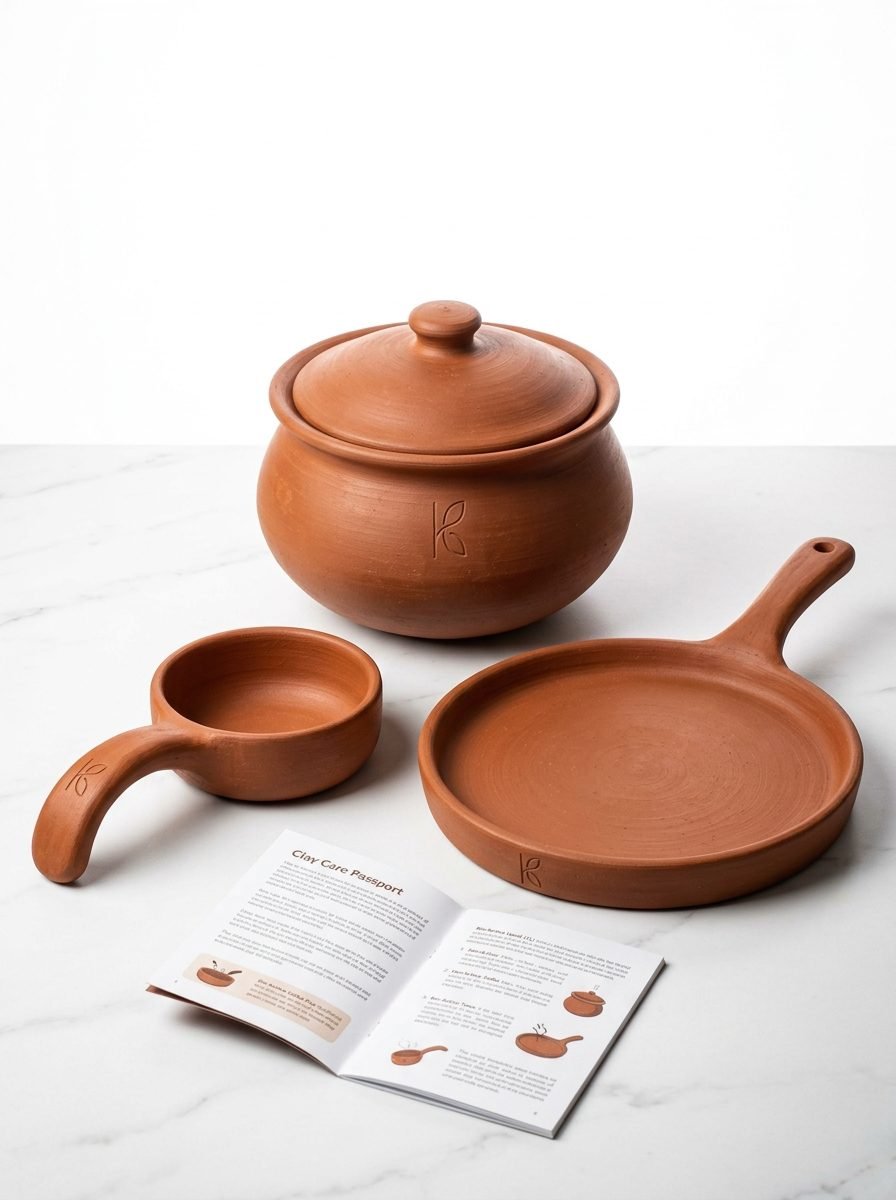
The Clay Care Passport is a booklet — linen-covered, beautifully printed — containing the complete annual care protocol for every Klayvi product. It comes with a 30ml bottle of cold-pressed flaxseed oil and a compressed rice husk scrubber. This is not a pamphlet. It is the reference document for a relationship between you and your clay that is supposed to last decades. Most people who have a bad experience with clay cookware have a bad experience because no one told them how to care for it. The Clay Care Passport is the solution to that.
Key Features & Benefits
- Flaxseed Oil — The Correct Seasoning Oil: Not sesame oil (too slow to polymerise). Not coconut oil (wrong fatty acid profile for clay bonding). Cold-pressed flaxseed oil specifically — it has the highest alpha-linolenic acid content (approximately 57%) of any common cooking oil, which is the fatty acid that polymerises most effectively onto clay surfaces at heat. One 30ml bottle: enough for three full seasoning cycles of a complete clay kitchen.
- Rice Husk Scrubber — The Correct Cleaning Tool: Compressed rice husk fiber is an abrasive gentle enough not to scratch the Ra ≤4µm clay surface but firm enough to remove food residue without soap. The natural silica in rice husk creates the specific abrasion level that clay requires. It is the only scrubber we recommend for daily clay use.
- Complete Annual Protocol: The Clay Care Passport is organised by product category and time interval: what to do on first use, weekly, monthly, annually. Each instruction is specific — not “season the clay” but the exact temperature, duration, oil quantity, and indicator of completion.
- Cooking Category Coverage: Separate sections for cookware (handi, kadhai, tawa, patila, sauce pan, tadka pan), drinkware, storage, and decor. Each section covers the specific care requirements of that product category, not generic advice.
- Re-Seasoning Rescue Protocol: A dedicated section for recovering clay vessels that have been washed with standard dish soap or improperly stored. The three-step rescue protocol restores the non-stick seasoning layer in approximately 48 hours of cooking.
- The 20-Year Guarantee: Clay that is properly cared for according to the Clay Care Passport will last 20+ years. The Passport is the document that makes that guarantee achievable. About the Product The Clay Care Passport cover is natural linen — the same tactile material as the quality of product it describes. The interior pages are printed on 100gsm uncoated paper with soy-based ink. The printing is full-colour throughout with diagrams showing exactly how to perform each care step visually. The flaxseed oil bottle is a 30ml amber glass bottle with a dropper top — amber to protect the photosensitive alpha-linolenic acid from UV degradation, dropper to ensure measured application (4–5 drops per seasoning cycle rather than a careless pour that wastes oil and over-oils the surface). The rice husk scrubber is a compressed disc of rice husk fiber bound with natural starch. It softens slightly with water and moulds gently to curved clay surfaces. Rinse and air-dry between uses. Each scrubber lasts approximately 3–4 months of daily use. The Science The chemistry of flaxseed oil seasoning on clay is the same chemistry that gives cast iron its non-stick surface: alpha-linolenic acid (ALA) undergoes thermal oxidative polymerisation at temperatures above 150°C. The ALA molecules cross-link with each other and bond to the mineral surface, creating a polymer network that fills the clay pores and creates a smooth, non-reactive surface layer. The specific advantage of ALA over other fatty acids for clay seasoning: its three double bonds (versus two for linoleic acid in sesame oil, zero for saturated fats in coconut oil) make it the most reactive in thermal polymerisation. The resulting polymer is harder, more resistant, and bonds more completely to the clay mineral surface than polymers from other oils.
Safety & Certification Standards
| XRF Analysis — Clay Source | Heavy metal screening on raw clay before production begins |
| ICP-OES — Finished Product | Parts-per-billion accuracy. Actual migration into food simulants at cooking temperatures |
| NABL-Accredited Laboratory | Internationally recognised test facility |
| FSSAI Food Contact Compliance | Meets India’s legal food safety standards |
| Per-Batch QR Report | Your batch. Your numbers. Published before dispatch. Scan and read it yourself. |
| Actual Lab Numbers | Compound |
| Klayvi Result | FSSAI Safe Limit |
| Lead (Pb) | ≤2.1 ppm |
| 90 ppm | Cadmium (Cd) |
| ≤0.3 ppm | 0.5 ppm |
| Arsenic (As) | ≤0.4 ppm |
| 2.0 ppm | Mercury (Hg) |
| Not detected | 0.5 ppm |
| PTFE / PFOA / PFAS | Not present |
Caring for Your Klayvi
| 1 — First Use | Rinse with plain water. No soap on first use. |
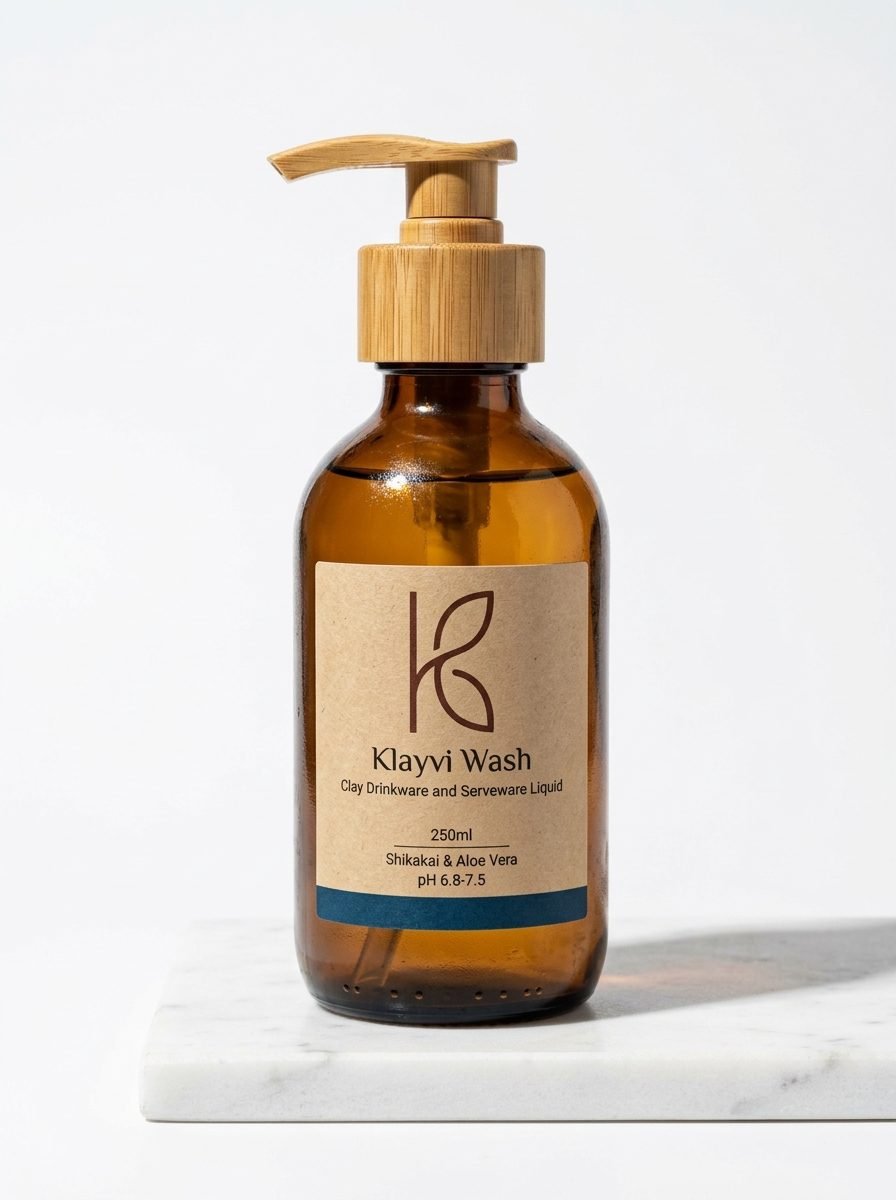
| 2 — Daily Clean | Klayvi Wash Care (pH 6–8) or sisal scrubber + warm water. Never standard dish soap. |
| 3 — After Wash | Dry completely on low flame (cookware) or air-dry (storage/decor). Never store damp. |
| 4 — Monthly | Apply 4–5 drops cold-pressed flaxseed oil. Heat medium-low ~4 min. Cool and wipe. |
| 5 — Never | Dishwasher · Microwave · Chemical detergents · Cold water on hot clay · Overnight soaking |
What’s in the Box
- Clay Care Passport (linen-covered booklet, full-colour)
- Cold-pressed flaxseed oil 30ml (amber glass dropper bottle)
- Rice husk scrubber disc
- Re-seasoning rescue protocol card
Frequently Asked Questions
Q: How often do I need to re-season my clay vessels?
Monthly for actively used cooking vessels. Once every 2–3 months for less-used pieces. Once annually for storage and decor pieces. The Clay Care Passport’s monthly calendar section has a simple tracking system.
Q: What if I run out of the flaxseed oil?
Cold-pressed flaxseed oil is available at health food stores, organic grocery stores, and online. Specify cold-pressed, not refined — the refining process removes the ALA that makes it effective for seasoning. The Klayvi website lists verified sources.
Q: Can I use the Care Passport for non-Klayvi clay vessels?
Yes. The care protocols in the Passport are based on terracotta and black clay science, not specific to Klayvi products. The Passport is useful for any unglazed or minimally glazed clay cookware.
Q: Is the rice husk scrubber suitable for glazed clay surfaces (Bone Kaolin)?
Yes — the rice husk abrasion level is gentle enough for the Bone Kaolin glaze on serving bowls, thalis, and vases. For the delicate Aqua-Lock glaze on drinkware, use the softer side of the scrubber only.
Q: What is the rescue protocol for soap-damaged clay?
Step 1: Apply 5–6 drops of flaxseed oil to the interior surface. Step 2: Heat on medium-low flame until the oil begins to smoke at the edges (approximately 4–5 minutes). Step 3: Turn off flame, let cool completely, wipe with a dry cloth. Repeat twice more. Total time: 3 seasoning cycles over 48 hours. The soap-stripped surface will be restored to functional non-stick level by the third cycle.
Q: Does the Clay Care Passport apply to the Khurja Black Clay slow cooker?
Yes — there is a dedicated Khurja Black Clay section in the Passport with specific care notes for the different porosity and mineral composition of Khurja clay. The flaxseed oil and rice husk scrubber are equally appropriate for Khurja black clay.
Related products
-
Out of Stock

-
Out of Stock
-
Out of Stock

Reviews
There are no reviews yet.